
×
 September 22, 2026
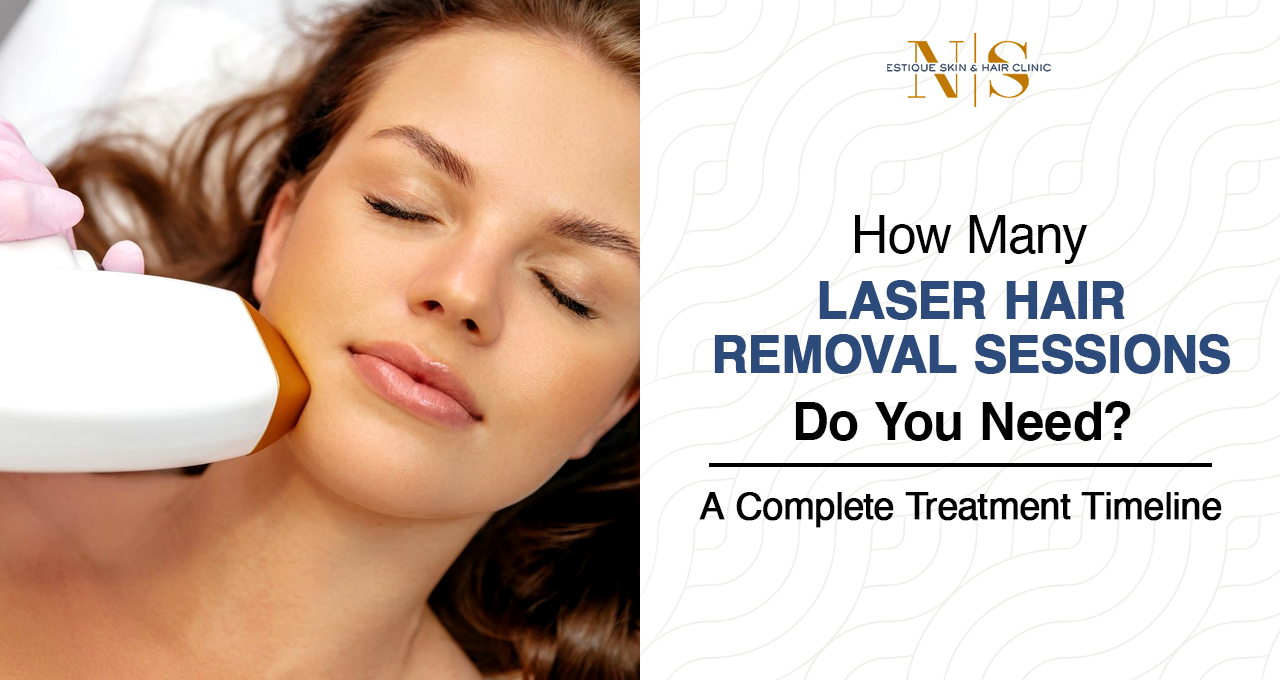
Most people need several laser hair removal sessions because not all hair follicles are active at the same time. Laser works best when the hair is in its active growth phase. At one appointment, some follicles are active while others are resting.
Repeated sessions are needed so that more follicles can be treated as they enter the active phase. Many patients start with around six sessions, but the exact number can vary. Hair thickness, hair colour, skin type, body area, hormonal factors and response to treatment all affect the final treatment plan.
Hair grows through a continuous biological cycle in which each follicle moves independently through periods of active growth, transition, and rest. The main stages are:
Anagen, catagen, and telogen are the three main stages of the hair growth cycle.
The length of each stage varies across different body areas. This is why facial hair, underarm hair, and leg hair may need different treatment intervals.
Laser hair reduction works through a principle called selective photothermolysis. This means that a specific wavelength of laser light is selected to target a specific pigment while reducing unnecessary heating of nearby skin.
In hair removal, the main target is melanin, the pigment present in the hair shaft and follicle. A substance that absorbs laser light is called a chromophore. In laser hair removal, melanin acts as the chromophore.
The absorbed light is converted into heat. This heat affects structures within the follicle that are responsible for producing new hair. This is also why dark and coarse hair generally responds better than grey, white or very light hair. Dark hair contains more melanin and provides a stronger target for the laser.
Around six sessions are commonly used as an initial treatment course, but there is no fixed number for every patient. Clinical studies have used different treatment schedules depending on the laser system, body area and patient group.
For example, one study using a long-pulsed alexandrite laser involved an average of about 5.6 treatment sessions, commonly performed four to six weeks apart. Other studies have used treatment courses ranging from approximately three to eight sessions.
The number of sessions should therefore be based on the patient’s response rather than a fixed package.
The first session targets hairs that are in the active growth phase at that time. Not all hair will disappear after the first session. Some follicles will still be in resting or transition phases. Treated hairs may begin to shed over the following days or weeks.
By the next few sessions, another group of follicles has entered anagen. Patients may begin to notice slower regrowth, lower hair density or finer hair. The doctor may also review the skin response and adjust laser settings if required.
Later sessions treat follicles that were not active during earlier appointments. At this stage, the remaining hair may be less dense or finer. The response should then be reviewed to decide whether more sessions are needed. This is why laser hair reduction is a more accurate medical term than expecting complete and permanent removal of every hair follicle.
Clinical research supports long-term reduction in hair growth, but results vary between patients and devices.
A 2022 systematic review found long-term hair reduction with Nd: YAG, alexandrite and diode lasers. The authors also noted that results differed between studies and that long-term evidence was still limited in some areas.
A 2023 network meta-analysis of 13 randomised trials also found that laser treatments reduced hair counts. However, the study did not show that one laser type was clearly superior in all patients.
This suggests that the laser device is only one part of treatment. Skin type, hair characteristics and treatment settings are also important.
Laser treatment is controlled by several technical settings. One important term is fluence. Fluence is the amount of laser energy delivered over a defined area of skin. It is usually measured in joules per square centimetre.
Another term is pulse duration, which describes how long each laser pulse is delivered. Laser treatment also considers thermal relaxation time. This is the time a heated structure takes to lose much of its heat to nearby tissue.
Wavelength, fluence, pulse duration, spot size and cooling work together. These settings help determine how much heat reaches the follicle and how the surrounding skin responds.
Skin contains melanin as well as hair. This means the laser must target the pigment in the hair while reducing unnecessary absorption by the surrounding skin.
Doctors may use the Fitzpatrick skin type classification to assess how the skin responds to sun exposure and how much pigment is present.
Darker skin contains more epidermal melanin. This can absorb part of the laser energy, so wavelength and treatment settings need to be selected carefully. The aim is to heat the hair follicle without causing excessive thermal injury to the skin.
Many laser hair removal sessions are initially spaced around four to six weeks apart. The exact interval depends on the body area and pattern of hair regrowth the patient has.
Sessions performed too close together may not improve results because enough new follicles may not yet have entered the anagen phase. As hair growth becomes slower, later sessions may also be spaced further apart.
If you want to know about the number of sessions needed, then it is better for you to know that there are several factors which influence treatment response.
Dark, coarse hair usually responds better because it contains more melanin. Very light, grey or white hair may respond poorly because there is less pigment available for the laser to target.
Hair growth cycles differ between the face, underarms, legs, chest and back. The number and spacing of sessions may therefore differ between areas.
Hormonal changes can continue to stimulate facial or body hair. Patients with increased androgen activity may need more sessions or later maintenance treatment. This can also affect the treatment plan for laser hair removal for men.
Laser hair removal cost per session depends on the size of the area, treatment time, technology used and number of sessions required.
When checking laser hair reduction cost in Gurgaon, it is useful to consider the complete treatment plan rather than only the cost of one session.
At Estique Clinic, laser hair reduction is offered as part of the clinic’s laser and energy-based treatments. The clinic is led by Dr Neha Sharma, an MD dermatologist with more than 15 years of clinical experience.
The treatment plan should consider skin type, hair colour, hair thickness, body area and pattern of regrowth.
Patients when they are looking for the best skin specialist in Gurgaon, should also consider about how their skin and hair are assessed before the treatment. Laser settings are also worth considering at this research phase.
No. Only some hair follicles are in the active growth phase during one session. Other follicles need to be treated in later sessions.
Six sessions are commonly used as an initial estimate. Some patients may need fewer or additional sessions depending on hair type, body area and hormonal factors.
Some follicles may have been in a resting phase during treatment. They can become active later and produce visible hair.
Yes. Shaving removes hair above the skin without removing the follicle. Waxing or plucking can remove the follicular target needed for laser treatment.
Some patients may need maintenance sessions if hair regrows later. This can occur due to remaining follicles or hormonal changes.





Experience Exceptional Skin Care From Our Best Skin Doctor In Gurgaon
Clinic Timings
Monday to Friday : 10 AM to 7 PM
Saturday : 10 AM till 6:30 PM
12, first floor, Palm Springs Plaza, Golf Course Rd, DLF Phase 5, Sector 54, Gurugram, Haryana 122003
1021/1022, Behind 32nd Avenue, Sector 15 part 2, Gurugram, Haryana 122001

Medical and Cosmetic Dermatologist and well renowned as the Best Dermatologist in Gurgaon, has formerly practised in prestigious Hospitals such as VMMC & Safdarjung Hospital (New Delhi) and All India Institute of Medical Sciences (AIIMS, New Delhi).
It just takes a few minutes to book a visit online.
We at Estique clinic believe in understanding your problems and then suggest the treatment for best results.
Copyright 2017-2026© Estique Skin And Hair Clinic. Privacy Policy